Trenching is narrow excavation to a set depth and grade for water, power, gas, fibre and drainage lines. In the Fraser Valley, straightforward trenching in workable ground typically prices out between $12 and $30 per linear foot including backfill, with hourly rates from about $130 per hour and a half-day minimum on short runs. BC 1 Call locates come first, always.
What Do We Trench For?
Trenching is precision excavation: a narrow cut at a specified depth and grade, bedded so the line inside survives for decades, then backfilled so the surface does not sink. We trench for water services, underground electrical feeds, gas line routes, communications conduit, and drainage lines across the Fraser Valley, most often on acreages where a new shop, barn or suite needs services run from the road or the main house.
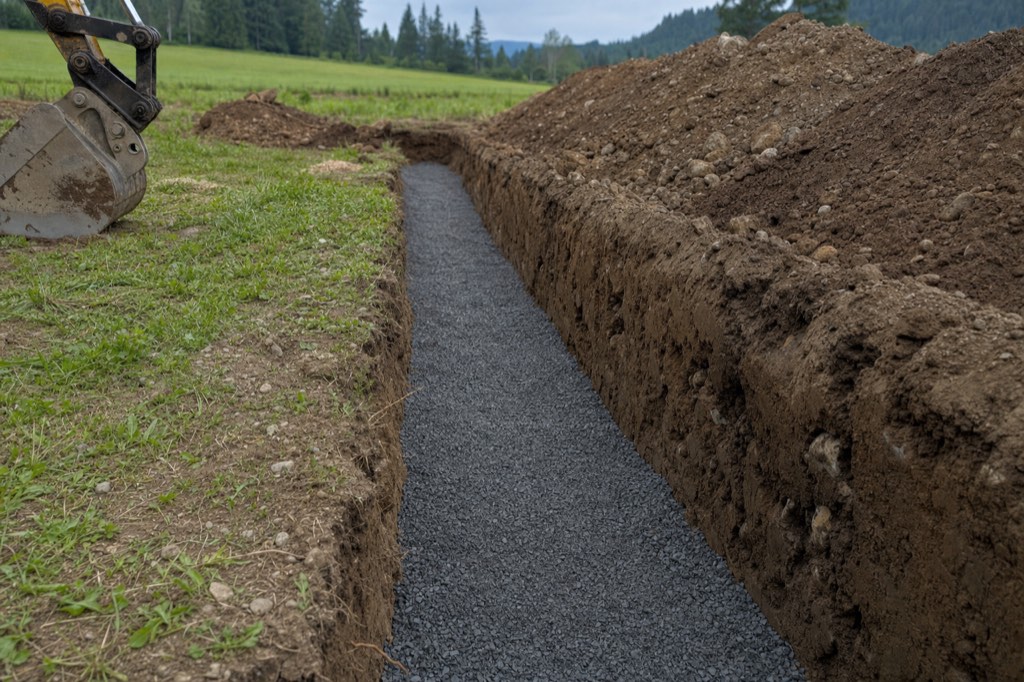
- Water services, from the municipal connection or well to the house, and from the house out to barns, gardens and stock waterers
- Underground power, conduit runs to shops, barns, coach houses and gate entrances, dug to your electrician's specification
- Gas line trenches, dug for your licensed gas fitter's installation
- Communications conduit, fibre and low-voltage runs, often shared with a power trench to save money
- Perimeter and storm drainage, footing drains, downspout runs and culvert tie-ins
- Irrigation mains for farms, nurseries and large gardens
Do You Have to Call BC 1 Call Before Trenching?
Yes, and it is free. The request goes in at least three business days ahead so utility owners can mark their buried lines before a bucket moves.
Every trenching job starts with a BC 1 Call locate request, submitted at least three business days before digging. It is a free service that notifies the owners of buried gas, electrical and communication lines so they can mark their locations. Hitting a gas main is dangerous; hitting a fibre trunk is astonishingly expensive; and in both cases the excavator who skipped locates owns the problem. We do not skip locates. Ever.
Just as important: BC 1 Call only knows about registered utilities. The water line a previous owner ran to the barn in 1988, the septic field, the irrigation main, the wire to the gate light, none of it is in the database. Before we dig we walk the route with you, check old drawings and permits where they exist, and hand-expose anything uncertain. Careful beats fast, every time.
How Deep Does a Utility Trench Have to Be?
It depends on the service, not on the trench. Water lines are dug for frost cover, electrical for code and installation type, and drainage for grade.
Each service has its own depth rules. Water lines in the Fraser Valley typically need at least 600 mm of cover for frost protection, and many inspectors want more. Electrical conduit depth depends on the installation type, commonly in the 600 mm to 1 metre range, set by your electrician and the electrical code. Drainage runs are governed by grade rather than frost: a steady fall, no bellies, no reverse slopes.
- Dig to specified depth and grade, with the trench bottom cleaned of rocks and loose spoil.
- Bed the line in sand or fine gravel so it rests on uniform support instead of point-loading on stones.
- Cover and flag: more bedding over the pipe, marker tape above conduit runs, and inspection access preserved where the trade needs it.
- Backfill in compacted lifts, so the trench line does not appear as a sunken stripe across your lawn or driveway next winter.
| Service | What sets the depth | Who signs off |
|---|---|---|
| Water service | Frost cover, typically at least 600 mm in the Fraser Valley | Municipal inspector or plumber |
| Underground electrical | Installation type and the electrical code, commonly 600 mm to 1 m | Your electrician |
| Gas line | Your licensed gas fitter's installation requirements | Licensed gas fitter |
| Fibre and low-voltage conduit | Usually shares a power trench, with required separation | Installing contractor |
| Drainage line | Continuous fall to the outlet, not frost depth | Grade checked on site |
What Makes Fraser Valley Ground Hard to Trench?
Three things, depending where you are: silt that slumps when wet, hardpan that is stable but slow, and hillside rock and roots that force the trench to be benched.
Trench conditions here vary street by street. The silts around Sumas Prairie and the lower Chilliwack flats cut like butter but slump when wet and can need dewatering in winter. Langley and Abbotsford hardpan is stable but slow digging. Mission hillsides and Sumas Mountain add rock, roots and slope, where the trench has to be benched or stepped to keep grade. We have dug in all of it, and the quote reflects your actual ground, not a fantasy average.
Wet season trenching is often fine, and sometimes unavoidable when a water line fails in January. Open trenches in saturated soil need faster turnaround, pumps on hand, and backfill material that compacts when native spoil will not. We plan for that instead of discovering it.
When Does a Trench Need Shoring or Sloping?
At 1.2 metres deep. WorkSafeBC requires trenches that deep or deeper to be sloped, benched or shored before anyone enters them.
Trench safety is regulated for good reason: soil collapses kill workers every year. WorkSafeBC requires trenches 1.2 metres or deeper to be sloped, benched or shored before anyone enters them. Most residential service trenches stay shallower than that or are worked entirely from outside the trench, which is how we plan them wherever possible. When a deep trench is genuinely needed, it gets engineered protection, not bravado.
What Trenching Jobs Do We Quote Most Often?
Service runs to new outbuildings, and failed lines that have to be replaced. These six make up most of the trenching we do across the valley.
- New water service from meter to house, or replacement of a failing poly line
- Power and data trench from house panel to a new shop, 30 to 150 metre runs
- Service trenches for a mobile home, suite or coach house
- Stock waterer and irrigation main trenching on farm properties
- Downspout and perimeter drain runs to daylight or a rock pit
- Culvert and driveway drainage tie-ins on rural frontages
Frequently Asked Questions
How much does trenching cost in the Fraser Valley?
Straightforward trenching in workable ground typically prices out between $12 and $30 per linear foot including backfill, with hourly machine rates (about $130 to $180 per hour for a mini excavator) and a half-day minimum applying to short runs. Rock, roots, deep trenches, dewatering and hand-digging around existing services push the price up. We quote a firm number per run after seeing the route.
How deep does a water line need to be buried in BC?
In the Lower Mainland and Fraser Valley, water lines are typically buried at least 600 mm (about 24 inches) deep to protect against our relatively shallow frost, and many municipalities and plumbing inspectors want 750 mm or more of cover. Your plumbing permit sets the final number. We dig to the required depth with proper bedding so the line passes inspection the first time.
Who calls BC 1 Call, you or me?
We do, as part of every trenching job. BC 1 Call is the free provincial service that notifies gas, hydro and telecom owners to mark their buried lines, and requests need to go in at least three business days before digging. No locate, no dig, no exceptions. Remember that private lines you or a previous owner installed (septic, irrigation, power to a shop) are not registered, so we walk the route with you too.
Can you trench for power out to my shop or barn?
Yes, trenching for underground electrical feeds to shops, barns and outbuildings is one of our most common acreage jobs. Your electrician specifies the depth and conduit (commonly around 600 mm to 1 metre of cover depending on the installation), we dig and bed the trench, the electrician lays and inspects the run, and we backfill with warning tape placed above the conduit. Coordinating the two trades on one schedule is routine for us.
What is trench bedding and why does it matter?
Bedding is the layer of sand or fine gravel placed under and around a pipe or conduit before backfilling, and it is what protects the line from rocks and from settling into low spots that create bellies. A water line laid on native lumpy ground fails years earlier than one on proper bedding. We bed every service line we trench and compact backfill in lifts so your lawn or driveway does not sink along the route.
Can you dig safely near my septic system?
Yes, but it takes care and honesty about where things are. Septic tanks and fields do not appear in BC 1 Call records, so we locate them from your records, the health authority filing, or careful exploratory digging. We keep machine loads off the field, hand-expose near tanks and lines, and route new trenches at safe distances so a $2,000 trench never becomes a $20,000 septic repair.