A gravel driveway that lasts is a structure, not a load of rock: excavated subgrade, separation fabric on soft ground, compacted lifts of crushed rock, a crown that sheds water and a culvert where it crosses a ditch. Built that way in the Fraser Valley it costs about $3 to $6 per square foot and lasts decades with light maintenance.
Why Does a Driveway Need to Be Built Like a Road?
Because it carries the same loads a road does, on the same soft valley ground. Gravel dumped on grass has no structure to spread that load, so it sinks.
A gravel driveway that lasts is a structure: excavated subgrade, separation fabric where the ground is soft, compacted lifts of the right crushed rock, a crown that sheds water, and ditches or culverts that carry that water away. A driveway that fails is usually just gravel dumped on grass. In the Fraser Valley, where long rural driveways cross silt, clay and everything in between, the difference shows up by the first February: one stays firm, the other becomes a rutted soup that eats another load of gravel every year.
We build new driveways, rebuild failed ones, and construct gravel yards, parking pads, RV pads and equipment areas for acreages and farms across Abbotsford, Chilliwack, Mission, Langley and beyond. Everything from a 30 foot suburban side-drive to a 400 metre farm lane.
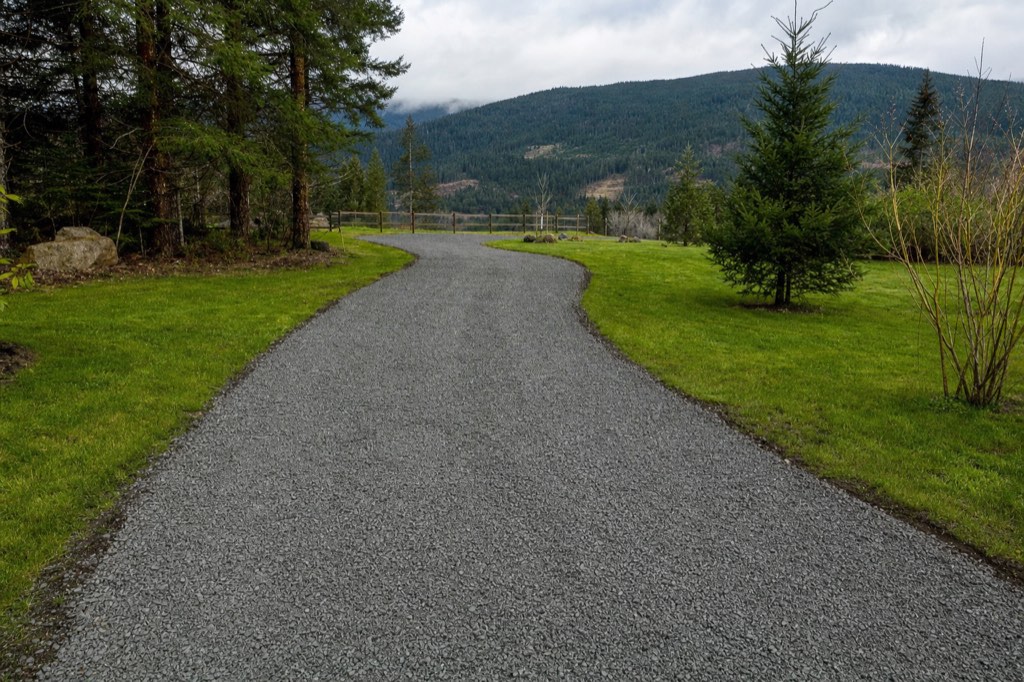
How Do You Build a Gravel Driveway That Lasts?
In six stages, bottom up. Five of them are invisible once the job is done, which is exactly why cheap driveways skip them.
- Layout and drainage plan. The route is set for grade and drainage first, appearance second. Every metre of driveway needs a place to shed its water: crown, ditch, swale or culvert.
- Excavation to firm ground. Topsoil and organics come out of the running surface. Building on organic material guarantees settlement, so we dig until the ground is real, typically 20 to 40 cm down, deeper in soft spots.
- Geotextile separation. On silt and clay subgrades, woven geotextile keeps the gravel and the mud from trading places. It is cheap insurance that doubles the life of a driveway on soft Fraser Valley ground.
- Base lift. In soft conditions, a lift of larger rock (often 3 inch minus) goes down first and gets compacted to form the structural platform.
- Surface lift. 3/4 inch minus crushed gravel, graded to a centre crown of a few percent and compacted with a roller or plate. Crushed rock with fines locks tight; round rock never does.
- Edges and details. Culverts at ditch crossings, armoured ends, transitions at the garage apron and the road, and clean shoulders so mowing and plowing are easy.
Do You Need a Culvert Where the Driveway Meets the Road?
Where a driveway meets a rural road there is usually a ditch, and where it crosses one there must be a culvert. Municipalities across the valley regulate new and widened accesses, commonly requiring an access permit and setting minimum culvert sizes. Getting this detail wrong floods your own frontage and your neighbour's, so we set culverts at correct grade on compacted bedding, protect the inlet and outlet, and keep the ditch flowing. On longer driveways we cut interceptor swales on the uphill side so storm water crosses under, not over, your running surface. For bigger water problems on the route, see our drainage and ditching work.
What About Farm Yards, Shop Aprons and Parking Pads?
The same structure that carries a car up a driveway carries a tractor across a yard. We build gravel yards and aprons around shop and barn pads, equipment parking, RV and trailer pads, and the high-traffic zones that turn to mud every winter: gate entrances, barn doorways, waterer surrounds. Farm traffic is heavier than residential, so lifts get thicker and compaction matters more. Built once, properly, these areas stay out of the mud for many seasons with nothing more than occasional regrading.
What Changes on Hillside and Long Rural Driveways?
Driveways climbing the Mission hills or Sumas Mountain bring grade and erosion into the picture. Water accelerates downhill, and a straight steep gravel drive becomes a flume that carries its own surface to the bottom. The counters are established practice: keep grades workable with switchbacks or route choice, install cross-drainage at intervals, armour the steep pitches with coarser rock, and bench the road into the slope properly rather than casting loose fill over the edge. Where a cut needs holding, we excavate for retaining walls as part of the same job.
How Much Does a Gravel Driveway Cost?
About $3 to $6 per square foot for a full-depth new build in the Fraser Valley. Typical projects at that rate:
| Driveway | Approximate area | Typical cost |
|---|---|---|
| Suburban side drive, 12 ft by 60 ft | 720 sq ft | $2,200 to $4,300 |
| Standard rural entry, 12 ft by 100 ft | 1,200 sq ft | $3,500 to $7,500 |
| Acreage lane, 12 ft by 200 ft | 2,400 sq ft | $7,000 to $15,000 |
| Resurface over a sound base | Any | Priced from crush tonnage and machine time, far less than a rebuild |
| Culvert at a ditch crossing | Per crossing | Added to the quote, permit dependent |
Driveway quotes are built from measurable things: length, width, depth of excavation, fabric, tonnes of rock, trucking distance and culverts. That is why we quote firm, per project, after walking the route. Typical Fraser Valley pricing runs about $3 to $6 per square foot for a full-depth new build and far less for resurfacing, with long driveways gaining efficiency on trucking. The quote lists what goes into the ground so you can compare like for like against any other bid.
Frequently Asked Questions
How much does a gravel driveway cost in the Fraser Valley?
A properly built gravel driveway typically costs about $3 to $6 per square foot in the Fraser Valley, so a 12 foot wide, 100 foot long drive commonly lands between $3,500 and $7,500 including excavation, geotextile, base and surface gravel, while a 200 foot rural lane at the same width lands closer to $7,000 to $15,000. Resurfacing a driveway whose base is still sound costs far less, because it is priced from crush tonnage and machine time rather than full-depth construction. Long rural driveways benefit from economies of scale on trucking, and we quote them per project after seeing the route.
Why do gravel driveways develop potholes and soft spots?
Because gravel was placed straight on topsoil or wet native ground without excavation, fabric or compaction, so the stone slowly sinks and the mud pumps up through it. A driveway is a road: it needs the organic layer removed, a compacted subgrade, geotextile separation in soft ground, and compacted lifts of the right rock. Built that way, it sheds water and holds shape for years with only light maintenance.
What kind of gravel should a driveway use?
The standard Fraser Valley recipe is larger clean or minus rock (often 3 inch minus) as a base lift in soft conditions, topped with 3/4 inch minus crushed gravel (road base or road mulch) as the running surface, compacted in lifts. The word minus matters: crushed rock with fines locks together when compacted, while round drain rock never tightens up and rolls underfoot. We size the lifts to your ground and traffic, heavier for trucks, horse trailers and RVs.
Do I need a culvert where my driveway meets the road?
If there is a roadside ditch, yes, and the municipality usually has rules about the culvert size and installation at your access, with a permit often required for new or widened accesses. An undersized or missing culvert backs up the ditch, floods your frontage and erodes the driveway apron. We supply and set properly sized culverts at correct grade, bedded and armoured at the ends.
Can you fix the muddy area in front of my barn or gate?
Yes, high-traffic mud around gates, barn doors and stock waterers is one of our most common small jobs. The fix is the same as a driveway in miniature: dig out the churned organic muck, get down to firm ground, lay geotextile, and build back with compacted road base, crowned so water runs off. Done properly it survives hooves and tractor tires through a full wet season.
When is the best time to build a gravel driveway?
Dry season, April through September, is ideal because the subgrade compacts properly and trucks do not tear up the route. That said, an existing driveway can be resurfaced almost any time, and emergency repairs to keep a rural property accessible in winter are part of our regular work. If you want a new driveway for next winter, book it for summer construction.